How Fit Are You? Five Strength Tests for Your 50s

Strength training is a must for maintaining optimal health and function throughout life. If you’re in your fifties, you can — and should — start strength training.

“As you age, strength training becomes even more important than cardio,” says Melissa Leber, MD, associate professor of orthopedics and emergency medicine at the Icahn School of Medicine at Mount Sinai in New York City. Strengthening the muscles helps combat age-related muscle and bone loss, so you can keep up with daily tasks and avoid injury.

Curious how your strength is holding up? Put your body to the test with the following five exercises.
5 Exercises Experts Say Fit People Should Be Able to Do at 50

To evaluate your strength in your fifties, use the following five at-home tests suggested by Dr. Leber and Susane Pata, a National Association of Sports Medicine (NASM)–certified personal trainer in Miami. These exercises test your ability to maintain balance (muscular strength helps you maintain balance), as well as the strength of your leg, core, and upper body muscles.

Don’t stress if you can’t do all of the tests. After all, everybody’s fitness level is different, and if you haven’t been strength training, these may be more difficult for you than somebody who’s been strength training for years, Leber says. So use them as a baseline to measure where your strength is right now. You can then work on building strength over the next few months and test again to see if you’ve improved.

All you need to do these tests is a timer and a sturdy wall, though you may also want an exercise mat for floor exercises. Do these tests barefoot or wear comfortable athletic shoes.

1. One-Foot Balance

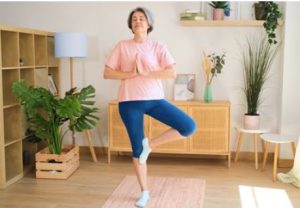
1. One-Foot Balance From standing, shift your weight onto one leg and lift the other foot a few inches off the floor. Start your timer and see if you can maintain your balance without holding onto a wall or chair for support for 1 minute.

2. Sitting-Rising Test

Sitting-Rising Test You’ll start this test with 10 points; your goal is to complete the test without losing any. Begin in a standing position. Cross one foot over the other and carefully sit cross-legged on the floor. Subtract a point every time you

3. Wall Sit

Wall Sit  Stand with your back against a sturdy wall. Then, walk your feet forward a foot or two and slide your back down the wall until your hips are at the same height as your knees and your knees are over your ankles.

4. Plank

Plank Get on the floor on your hands and position your wrists under your shoulders. Then, extend your legs behind you and place your toes on the ground. Your body should form a straight line from the top of your head to your heels.

5. Push-Up

Push-Up  Start in the same position as the plank with your hands and knees on the floor. To initiate a push-up, slowly bend your elbows backward, making a 45-degree angle with your torso. Lower your chest until it almost touches the floor

Why Maintaining Strength Later in Life Is Important

Working the muscles through strength training helps combat sarcopenia, the loss of muscle due to aging.

Around your thirties, you start losing roughly 3 to 8 percent muscle per decade.
Loss of muscle increases your risk of a lower quality of life, falls due to frailty, and hospitalization.


This is where strength training comes into play. “Although you’re still going to lose some muscle mass because of the aging process, strength training can help you fight that loss,” says Melissa Boyd, an NASM-certified trainer in San Francisco, and head coach at Tempo, a virtual personal training service.

When you strengthen your muscles, you’ll also strengthen your bones and joints. Stronger bones help fend off osteoporosis (a bone-weakening disease), but there are additional benefits from this trio effect. “You’ll improve your balance and spatial awareness, both of which get worse as you get older,” Leber says.

Injury prevention is another potential benefit. Your muscles and ligaments are more flexible and pliable when you’re younger. As you age, though, your muscles become more rigid, making you more prone to injury, Leber says. It also takes longer for your muscles to heal. When your muscles are strong, you’ll be better able to prevent and recover from injury, Leber says.

Your brain may even get a boost. After reviewing 39 studies with people over 50, researchers concluded that resistance training was associated with improvements in memory, regardless of whether they had existing cognitive issues or not.

Another study found that resistance training was effective in improving memory in older adults.

What to Know Before You Start Strength Training at 50-Plus

As with any exercise program, check with your doctor first. While there isn’t any inherent risk to doing strength training when you’re over 50, having joint or bone issues (like arthritis or osteoporosis), diabetes, or heart conditions (like heart disease or atherosclerosis, a hardening of the arteries) might require modifications, Boyd says.

It’s also beneficial to work with a qualified fitness professional to make sure you’re using correct exercise form and technique. Nailing proper exercise form and technique becomes even more important as you age, especially if you have arthritis in your joints or any issues with your spine, Leber says.

Boyd says to progress gradually in strength training. If, for instance, you’re using dumbbells to strength train, choose a light weight to start. Then gradually progress to using heavier weights and doing additional sets. Aim to do resistance training at least two times a week on nonconsecutive days.

The Takeaway

  • Strength training is essential for maintaining health and function with age.
  • There are several tests you can use to gauge how well your strength is holding up in your fifties.
  • Check with your doctor before starting a strength program, especially if you have heart conditions, diabetes, or joint or bone issues.

Leave a Reply

Your email address will not be published. Required fields are marked *