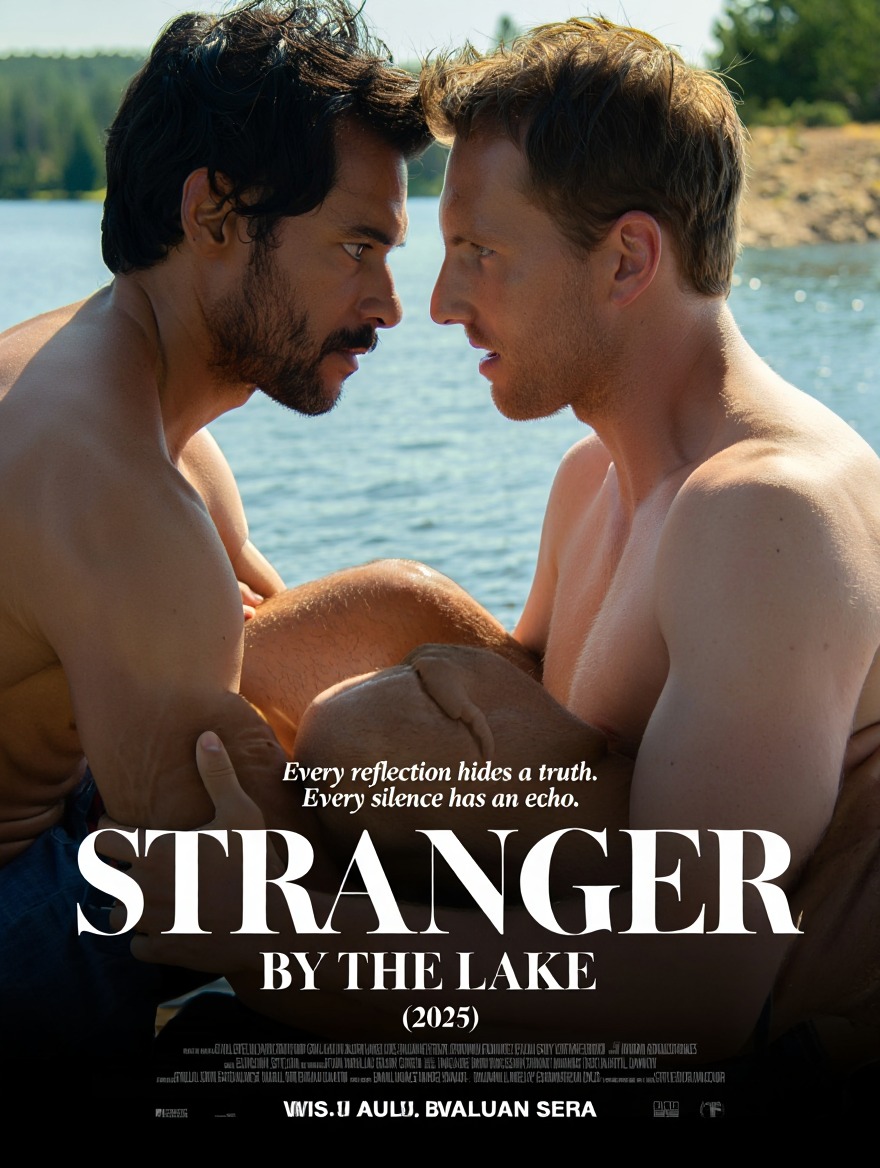
STRANGER BY THE LAKE (2025)
“Stranger by the Lake” (2025) emerges as a hauntingly beautiful reimagining of the psychological thriller genre — a film that blends erotic tension, emotional vulnerability, and slow-burning suspense into something both poetic and unsettling. Set against the backdrop of a remote lakeside community, the film explores the thin boundary between desire and danger, between intimacy and isolation. With its moody cinematography and unsettling stillness, the film captures the atmosphere of quiet dread that slowly builds into something explosive and unforgettable.

The story follows Adrien, a reserved man who retreats to a secluded lakeside cabin after a personal tragedy. There, he encounters a mysterious stranger named Lucas — charismatic, elusive, and dangerously magnetic. What begins as a tentative friendship evolves into an intoxicating relationship filled with passion and unease. The more Adrien is drawn into Lucas’s world, the more he senses that something dark lingers beneath the surface of the lake — and within Lucas himself. The screenplay unfolds deliberately, allowing each gesture, glance, and silence to reveal fragments of the characters’ hidden truths.

Director Claire Durand crafts an atmosphere of mounting tension through minimalism rather than excess. Long takes, natural lighting, and sparse dialogue transform the landscape into a psychological mirror, reflecting the inner turmoil of its characters. The sound design, too, becomes a central force — the rustle of wind, the ripple of water, and the distant calls of birds create an almost hypnotic rhythm that immerses the audience in the story’s world. Every frame feels alive with subtext, suggesting that what we fear most may not be what’s hiding in the dark, but what’s buried within ourselves.

Performances are nothing short of mesmerizing. Newcomer Julien Marchand delivers a deeply internal portrayal of Adrien — fragile, haunted, and quietly yearning — while Tomás Vega brings both danger and seduction to Lucas, balancing menace with moments of startling tenderness. Their chemistry is magnetic, charged with unspoken tension that keeps the audience guessing where love ends and obsession begins. Supporting performances, particularly from the local townsfolk, add texture to the film’s themes of secrecy and suspicion, transforming a simple lakeside setting into a microcosm of human fear and desire.

Visually, “Stranger by the Lake” is breathtaking. The cinematography makes the lake itself a character — vast, silent, and menacingly beautiful. At dawn, the mist dances over the water like memory; at night, the reflections shimmer like broken promises. The film’s palette shifts subtly from natural warmth to chilling cool tones as the story descends deeper into psychological darkness. Combined with an evocative score of minimalist strings and ambient echoes, the result is a sensory experience that lingers long after the credits roll.

Ultimately, “Stranger by the Lake” is not a film about monsters, but about the haunting spaces between people — where love, guilt, and danger converge. It’s a slow, hypnotic descent into obsession and self-discovery, crafted with precision and emotional honesty. This isn’t a movie that shouts; it whispers, and its whispers echo long after you leave the theater. Unsettling, sensual, and profoundly human, “Stranger by the Lake (2025)” stands as one of the most daring psychological dramas of the year.
⭐ Rating: 9/10